
Saif Gaddafi calls for democracy. Gamal Mubarak demands a fair trial. And we, the people? We’re just the scum!
Gamal Eid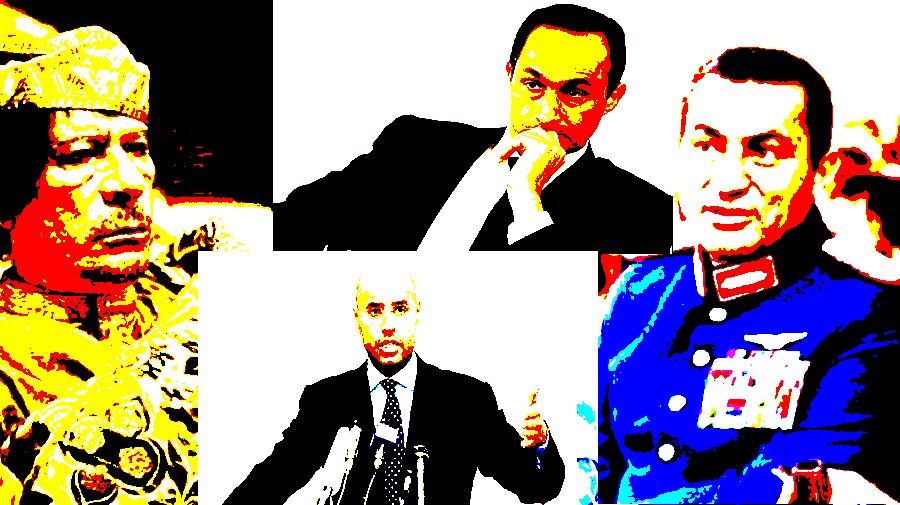
The resemblance between Saif al-Islam Gaddafi, son of Libya’s former dictator, and Gamal Mubarak, son of Egypt’s, is no coincidence — and it’s more than skin deep. It’s a resemblance in trajectory more than in appearance, in mindset more than in image. Both are products of essentially the same environment: a closed system of power, a state run as family inheritance, and a father who sat on his country’s chest for so long that his name became indistinguishable from the regime itself.
Both were raised inside a kind of authority that never rotated and never recognized the line between public and private. Influence was cultivated gradually, and each son was presented as the natural extension of rule — not as a response to the will of the people. By the early 2000s, both were on the rise, even as the regimes they stood to inherit appeared stable from the outside but were buckling under the weight of age from within.
By the year 2000, Muammar Gaddafi was 58, having ruled Libya for 31 years. That same year, Hosni Mubarak was past 72, with 19 of those years spent ruling Egypt.
Gaddafi’s heir — groomed in the shadows
Saif al-Islam Gaddafi was born in 1972, the second of Muammar Gaddafi’s sons, and by far the most politically positioned among his eight children — closest to the center of power, and most likely to inherit it. By the turn of the millennium, he was 28. And while his father continued to tighten his grip on Libya, those watching closely already understood that Saif was the heir apparent — with the father’s tacit approval, and quite possibly his direct orchestration.
From that point on, Saif’s name began to surface — not merely as the dictator’s son, but as a ruler-in-waiting. His public profile grew steadily, fueled by carefully curated activities designed to polish his image and repackage him in softer wrapping: less rough around the edges, more marketable — both at home and abroad. None of this happened in a vacuum. Between 1999 and 2000, hereditary succession had already swept through several Arab states, feeding the ambition and whetting the appetite for imitation.
In those years, Mohammed VI took the Moroccan throne after his father Hassan II; Bashar al-Assad inherited Syria from Hafez; Hamad bin Isa Al Khalifa assumed power in Bahrain following his father’s death; and Abdullah II became king of Jordan after Hussein. Four consecutive transfers of power that normalized dynastic rule as the default — not the exception.
Unlike those cases, Saif didn’t have to wait for his father to die. He was given something arguably more valuable: time — while the regime was still in full force — to prepare himself for what came next. He completed his studies in economics in Austria and then Britain, before easing into charitable work and later human rights advocacy, in a deliberate effort to reinvent himself as the reformist face of a system that had never known reform.
Human rights work — tailor-made for the heir
When it comes to human rights discourse in the Arab world at that time, two experiences stood out as the most prominent and influential: the Moroccan and the Egyptian. And since the Gaddafi regime faced its harshest criticism from Morocco’s independent press and rights organizations, it made sense that the search for a more accommodating cover would lead to Cairo.
That’s how a number of Egyptian human rights organizations were handpicked to play a functional role: propping up and polishing the image of the heir presumptive — the dictator-in-waiting — Saif al-Islam Gaddafi. The crowning achievement of this arrangement was his involvement in founding what was called the “Network for the Defense of Democracy.”
Most people have never heard of this so-called network, which was announced in 2008 with the participation of Egyptian rights organizations — the same organizations that maintained complete silence over the murder of Libyan journalist Daif al-Ghazal, who was tortured to death in 2005. A case no less brutal than — and arguably worse than — what happened to Italian researcher Giulio Regeni in Egypt in 2016.
And naturally, this network — neither under Saif Gaddafi’s leadership nor through its Egyptian partners — uttered a single word about the Abu Salim prison massacre. A slaughter that rivals the Rabaa al-Adawiya massacre for the title of one of the most horrific atrocities of the modern era in the Arab world.
The death toll at Rabaa, according to Egypt’s National Council for Human Rights, was around 624. Human Rights Watch puts it closer to 800. Muslim Brotherhood activists estimate roughly 1,000. The numbers vary, but one fact doesn’t: those people were killed in under twelve hours. At Abu Salim, approximately 1,200 were killed in roughly ten.
After the 2011 Libyan revolution, the International Criminal Court issued an arrest warrant for Saif al-Islam Gaddafi. A death sentence followed inside Libya in 2015. But the warrant was never enforced, and the sentence was never carried out. By 2016, the man was free — his name back in the spotlight, gearing up to run for the presidency of Libya.
A comeback that didn’t emerge from nowhere, but from a Libyan landscape weighed down by division, repression, and corruption — one that stirred in some Libyans a distorted nostalgia for the stability of tyranny. A scene reminiscent of when some Egyptians popularized the phrase “We’re sorry, Mr. President” — with one difference: the “president” here wasn’t just Gaddafi the father, but Gaddafi and his son… the founder of the “Network for the Defense of Democracy.”
Human rights work — tailor-made for the heir
When it comes to human rights discourse in the Arab world at that time, two experiences stood out as the most prominent and influential: the Moroccan and the Egyptian. And since the Gaddafi regime faced its harshest criticism from Morocco’s independent press and rights organizations, it made sense that the search for a more accommodating cover would lead to Cairo.
That’s how a number of Egyptian human rights organizations were handpicked to play a functional role: propping up and polishing the image of the heir presumptive — the dictator-in-waiting — Saif al-Islam Gaddafi. The crowning achievement of this arrangement was his involvement in founding what was called the “Network for the Defense of Democracy.”
Most people have never heard of this so-called network, which was announced in 2008 with the participation of Egyptian rights organizations — the same organizations that maintained complete silence over the murder of Libyan journalist Daif al-Ghazal, who was tortured to death in 2005. A case no less brutal than — and arguably worse than — what happened to Italian researcher Giulio Regeni in Egypt in 2016.
And naturally, this network — neither under Saif Gaddafi’s leadership nor through its Egyptian partners — uttered a single word about the Abu Salim prison massacre. A slaughter that rivals the Rabaa al-Adawiya massacre for the title of one of the most horrific atrocities of the modern era in the Arab world.
The death toll at Rabaa, according to Egypt’s National Council for Human Rights, was around 624. Human Rights Watch puts it closer to 800. Muslim Brotherhood activists estimate roughly 1,000. The numbers vary, but one fact doesn’t: those people were killed in under twelve hours. At Abu Salim, approximately 1,200 were killed in roughly ten.
After the 2011 Libyan revolution, the International Criminal Court issued an arrest warrant for Saif al-Islam Gaddafi. A death sentence followed inside Libya in 2015. But the warrant was never enforced, and the sentence was never carried out. By 2016, the man was free — his name back in the spotlight, gearing up to run for the presidency of Libya.
A comeback that didn’t emerge from nowhere, but from a Libyan landscape weighed down by division, repression, and corruption — one that stirred in some Libyans a distorted nostalgia for the stability of tyranny. A scene reminiscent of when some Egyptians popularized the phrase “We’re sorry, Mr. President” — with one difference: the “president” here wasn’t just Gaddafi the father, but Gaddafi and his son… the founder of the “Network for the Defense of Democracy.”
Gamal Mubarak — succession with a partisan flavor
As for Gamal Mubarak — also the second son of his dictator father — he was about nine years older than Saif al-Islam Gaddafi. Born in 1963, he was 37 by the year 2000, while Hosni Mubarak was entering his twentieth year in power, already past 72.
Where Saif Gaddafi took the route of charity, development, and human rights work — in a country where political party life was virtually nonexistent — Egypt, with its fragile but functioning partisan landscape, offered Gamal a different path. In 2000, he joined the National Democratic Party, and from that point his rise was swift, propelled by deep influence within the circles of power and the not-so-subtle hand of his mother. Talk of hereditary succession shifted from whispers in political salons to open — if carefully worded — demands.
But here’s the key difference between the two cases: Saif Gaddafi’s rise as his father’s likely successor unfolded in near-total silence, whereas in Egypt, the succession project was met with a growing wave of public rejection. Especially in a charged regional climate — in the aftermath of the Gulf War, the occupation of Iraq, and the humiliating fall of Saddam Hussein. At that moment, opposing hereditary rule became a central demand of the Kefaya movement, the Egyptian Campaign for Change (“Freedom Now”), the April 6 protests, and the “He Will Not Rule” movement — which later planted the first seeds of the National Association for Change.
Eventually, Gamal Mubarak stood trial alongside his father and older brother Alaa in a number of cases that lacked justice and fairness. Yes — the trials of Hosni Mubarak, Gamal, Alaa, and other regime figures were unfair trials.
Then, with the release of the Epstein documents, a letter surfaced — attributed to Gamal Mubarak’s wife — in which she relayed, in his words, his fear that neither he nor his father would receive a fair trial.
The irony here hardly needs elaboration: the heir to a regime that ruled without accountability for decades, afraid of injustice — only once he’s the one sitting in the dock.
Gamal Mubarak was right — the trial wasn’t fair
A fair trial isn’t only one that lacks the foundations of justice and convicts an innocent person. It’s equally unfair when those same foundations are absent and a guilty man walks free. In both cases, justice is missing — only the outcomes differ. By that measure, the trials of Hosni Mubarak, his sons, and his regime’s inner circle were anything but fair. They were chaotic, threadbare, and riddled with enough dysfunction to confirm that justice was never truly present.
After the January revolution toppled Mubarak and his family — but not his system — the dictator spent months in Sharm el-Sheikh, untouched by any real accountability. His trial only began under street pressure, driven by revolutionary protests still at their peak.
The trial opened in August 2011. Many of the lawyers who represented the families of the martyrs in that case — this writer among them — recall that it began with a serious violation: it was held inside the Police Academy, a facility under the Ministry of Interior. This wasn’t a procedural detail. It set a precedent that persists to this day — trials were subsequently moved from the Academy to the Police NCO Institute, then to new prisons in Badr, Tenth of Ramadan, and May — a pattern that reflects just how distorted the relationship between justice and its setting had become.
The case file itself was a mess — disjointed, and in many places, farcical. Recordings vanished. Documents related to troop deployment disappeared. Evidence that could have been decisive simply evaporated. Even the prosecution, before live broadcasting of the trials was cut, complained on air that its hands had been tied during the investigation. That wasn’t a figure of speech — it was an open admission of institutional paralysis in the pursuit of truth.
It was no surprise, then, that Counselor Ahmed Mekki — former Vice President of the Court of Cassation and member of the Supreme Judicial Council — called the whole thing a farce. A farce that dragged on for over forty sessions, during which the revolutionary tide receded, public pressure faded, and elements of the deep state quietly infiltrated the ranks of the lawyers — a silent rebalancing of power inside the courtroom.
In the end, the toll was staggering: corruption estimated in the billions, and more than 840 martyrs of the revolution — whose cases ended in reduced sentences or acquittals. Justice hollowed out from within, and a public memory worn down to the point of numbness.
And if Saif al-Islam Gaddafi was killed just days ago, Gamal Mubarak is still very much alive — enjoying the people’s money that was looted, basking in vast fortunes stashed in foreign banks, most notoriously in Switzerland.
If Libya’s collapse allowed Saif Gaddafi to escape justice — and even prepare to run for president before his death — then Gamal Mubarak, who doesn’t dare enter politics directly, speak publicly, or even hint at running for office, stands outside prison, a free man, living comfortably under the banner his and his father’s loyalists still carry: “We’re sorry, Mr. President.”
Us
As for us — the people — no one said it better than the Egyptian poet Abdel Rahman al-Abnudi:
“We are the people — the scum, the nobodies,
chasing what’s beautiful down the roughest road, beaten by the boot’s tip and the heel’s sharp edge.”
The article was published on the Zawiya 3:
https://zawia3.com/en/gamal-mubarak-and-saif-al-gaddafi/